
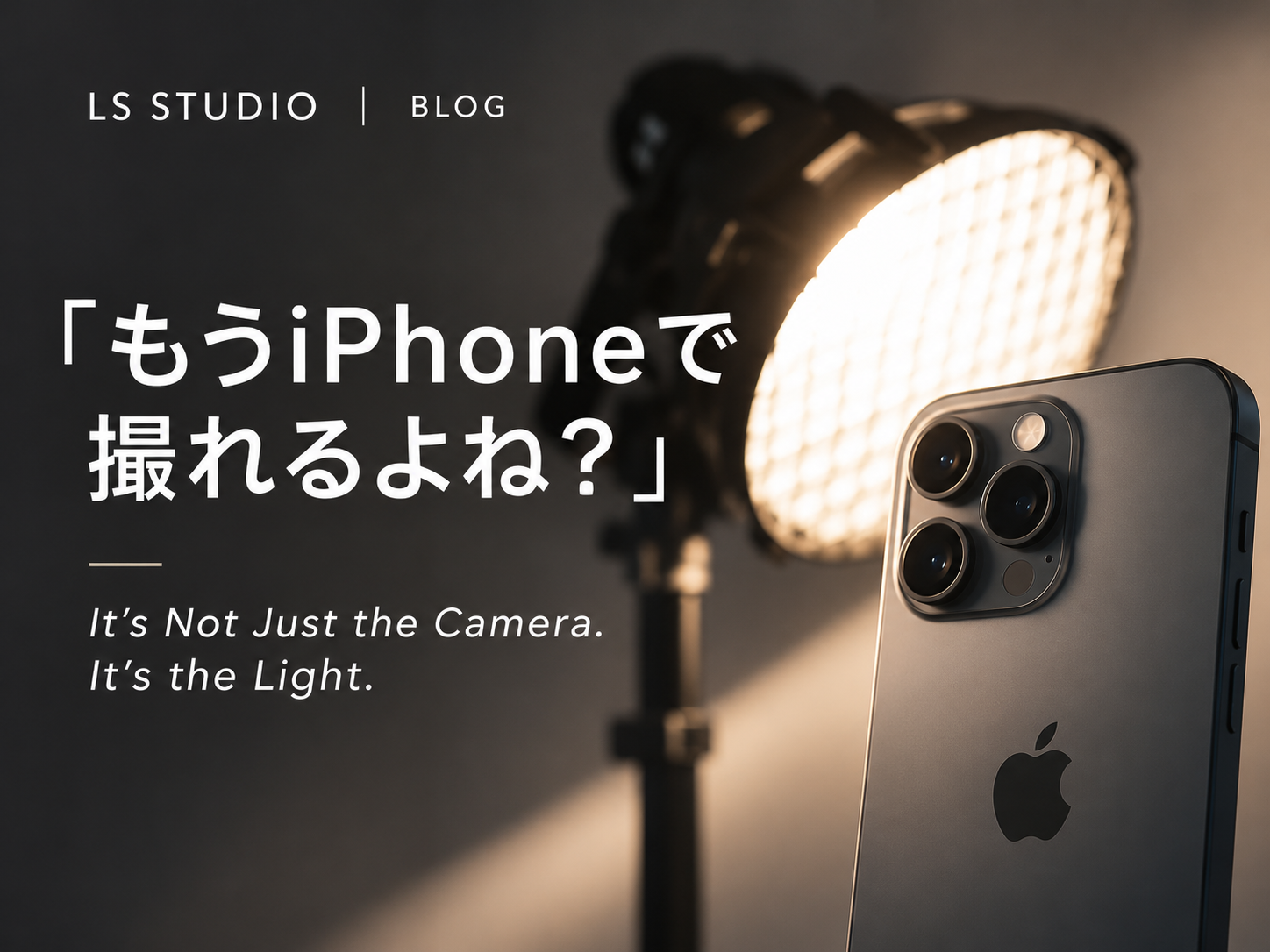
“Can’t You Just Shoot It on an iPhone Now?”
Creative & ProductionJournal / Case StudyProduct & BrandSNS
Now that cameras have come so far, why lighting matters more than ever.
The other day, while talking with the president of a company, I was told:
“You can shoot this on an iPhone now, right?”
And honestly, that’s true.
Recent iPhone cameras are superb. Beyond everyday snapshots, they can handle product shots, portraits and even video.
For photos used on social media or a website, a smartphone is sometimes enough.
So does that mean professional photographers are no longer needed?
Hearing that question made me think again about what photography as a job really is.
And there is one thing I want to say.
The beauty of a photograph is not decided by the camera’s performance alone.
01. Photographs are made of light
The English word “photography” comes from the Greek for “light” and “to draw or write.”
In other words, photography is drawing with light.
However high-performance the camera, the photograph changes enormously with the light.
Conversely, even with a smartphone, if you use light well you can take surprisingly beautiful photos.
Imagine photographing the same person in the same place.
Once lit only by the fluorescent lights on the ceiling, once by soft natural light coming through a window.
The person’s expression, the texture of their skin and the impression of the whole photo all change.
The camera didn’t change.
Only the light did.
02. Lighting is not about making things bright
When people hear “lighting,” they may picture using big lights to shoot everything brightly.
But the essence of lighting is not simply making the subject bright.
The direction, strength, softness and colour of light — and shadow.
By controlling these, you shape how the subject is perceived.
Take an executive portrait.
Even light across the whole face can give a bright, approachable impression.
Light from an angle with some shadow, on the other hand, creates dimension and can express a calm strength.
Neither is “correct.”
What matters is how you want to portray that person.
Lighting is not just a technique for making things look nice; it is a way of deciding what impression you want viewers to take from a photograph.
03. In product photography, light changes a product’s value
Light is just as important in product photography.
Take a ceramic bowl.
Strong light from the front reduces the shadows on its surface and can make its form and texture harder to read.
Light from an angle, on the other hand, brings out the curves of the bowl and the character of the glaze.
With glassware, what is reflected in the glass can matter more than the light itself.
With metal products, how you control reflections changes the impression of the material dramatically.
To take a luxurious product photo, you don’t necessarily need an expensive camera.
What matters more is understanding the subject’s material and creating light that brings out its appeal.
The same product can show a completely different face depending on the lighting.
04. Natural light is lighting too
I’ve been writing about lights, but I don’t think you always have to use artificial lighting.
In fact, there are many situations where I feel natural light is the most beautiful.
Morning light coming into a Kyoto machiya townhouse.
Soft light spreading through shoji paper screens.
Warm evening light slanting in.
Natural light like this has a quality that lighting equipment can never fully reproduce.
But using natural light is not the same as shooting without thinking.
Checking the direction the light comes from.
Choosing the time of day.
Moving the person slightly.
Sometimes bouncing light with a white board to soften the shadows.
All of this is lighting.
Even without lighting equipment, if you shoot with awareness of the light, you are designing the light.
05. Even on an iPhone, good lighting changes the photo
This is actually the part I most want to get across.
Professional photographers don’t use expensive cameras only for image quality.
Lens choice, handling, reliability, colour reproduction — there are many reasons they need them for the work.
That said, it is also true that for photos used on typical websites and social media, an iPhone is sometimes enough.
But even with the same iPhone, a photo taken without any thought for the light and one taken with lighting in mind look very different.
In other words, better cameras haven’t removed the need to understand light.
If anything, now that anyone can take high-resolution photos, how you use light may be what sets photographs apart.
06. What a professional photographer provides is not a camera
On a professional shoot, the job is not just making the photo look good.
Take a portrait for a company website.
Is the person an executive, a creator, a researcher?
What impression does the company want to convey?
Do you want viewers to feel trust, or warmth?
The lighting, background and composition change depending on those goals.
And when photographing several people, keeping a consistent tone across all the photos matters too.
Even in the same office, the light from the windows changes through the day.
Understanding those changes and adjusting the lighting as needed lets you maintain consistent quality.
In other words, a professional’s job is not simply shooting with a good camera.
It is creating light that fits the purpose, controlling the impression of the photograph, and delivering the required quality consistently.
I believe that skill and judgement are where a professional’s value lies.
07. Light creates emotion in a photograph
As a photographer, I am deeply interested in the relationship between light and shadow.
Because there is light, shadow is born; because there is shadow, we feel the light.
Making everything bright does not necessarily make a beautiful photo.
Sometimes leaving areas dark makes the subject’s presence stronger.
What to show, and what not to show.
That choice gives a photograph depth and room for the imagination.
Light doesn’t just make things visible.
It can express warmth or coolness, stillness, tension — even the passing of time.
Seen that way, lighting is a technique, but also the place where a photographer’s own sensibility shows.
08. My answer to “Can’t you just shoot it on an iPhone?”
If I’m asked the same thing again, I think I’ll answer like this:
“Yes, you can. And it will look pretty good.”
But I’d like to add one thing:
“The way you use light changes a photograph completely, though.”
We no longer live in an age when owning an expensive camera alone proves you are a professional.
AI is advancing too, and editing photos and generating images are far easier than before.
That is exactly why we need to think again about the fundamentals: what we photograph, and how.
A camera is a tool for recording light.
But how you find that light, how you shape it and how you express it —
that is where the photographer’s thinking and experience show.
Cameras keep evolving, but the ability to read light doesn’t come with the camera.
That, to me, is what makes photography fascinating, and one of the skills professional photographers must keep refining.
LS STUDIO | Photography & Creative Production
Kyoto, Japan