
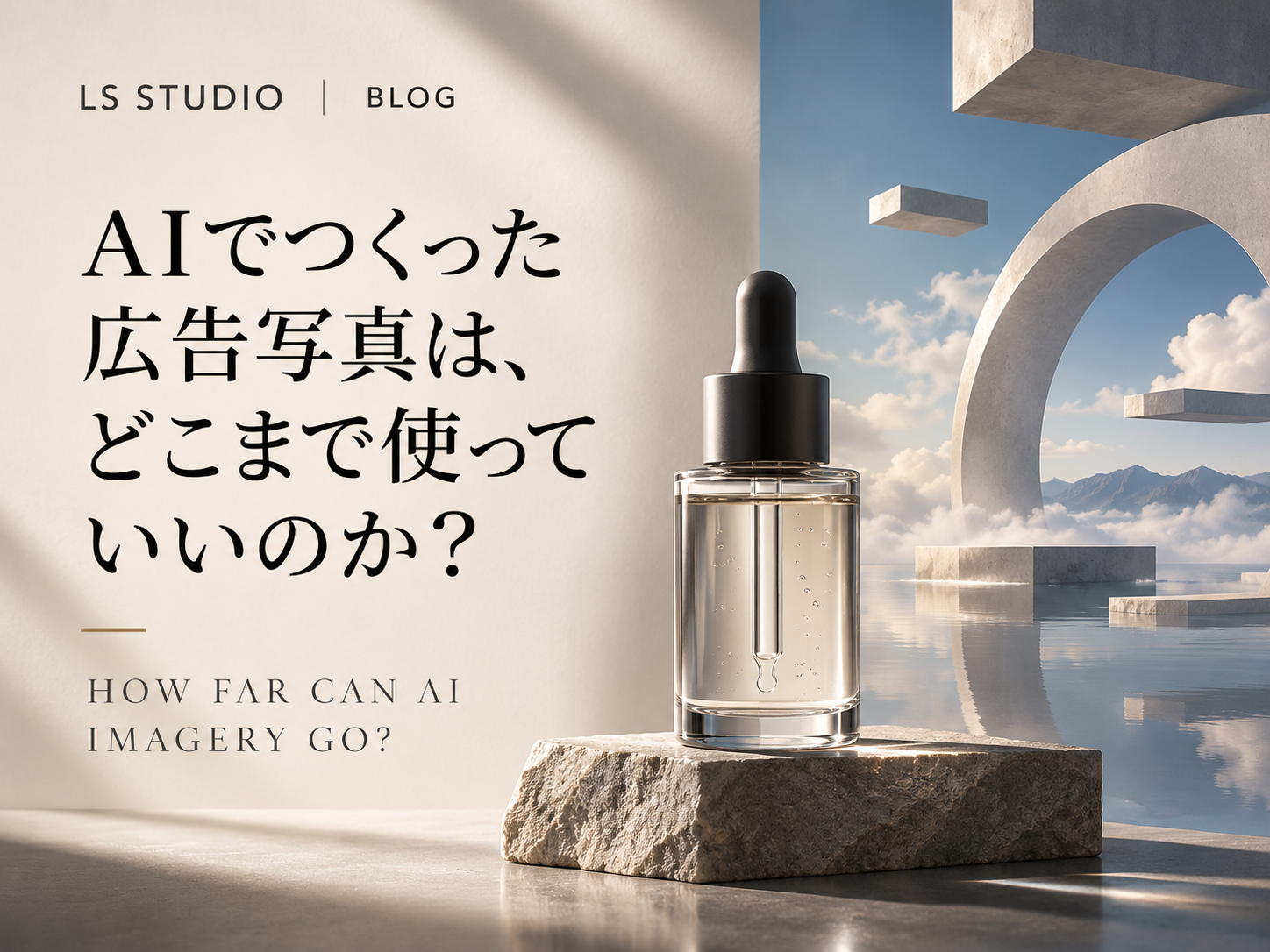
How Far Can You Go with AI-Generated Advertising Images?
AI AdvertisingJournal / Case StudySNS
Thinking about “truth” and “fiction” in photography, now that anyone can make beautiful images.
We are seeing more and more advertising images made with AI.
Models who don’t exist, beautiful architectural spaces, dreamlike landscapes.
You can place a product and create a visual that looks as if it were shot in a high-end studio abroad.
And compared with a traditional shoot, it can sometimes save time and money.
For advertising production, it is a very attractive technology.
But it raises a question.
How far can you go in using AI-generated advertising images?
Changing the background to show a product beautifully, versus showing something different from the actual product.
Where is the line between them?
Here I want to think about the relationship between AI and advertising photography, as a photographer and as someone who works in advertising production.
01. Advertising photography has always staged reality
Advertising photography has never simply recorded reality as it is.
Working on the lighting to make a product look beautiful.
Arranging props in the background.
Adjusting the plating so food looks delicious.
Correcting colour and contrast.
All of this was being done long before AI arrived.
An advertising photograph is not just a record of reality; it is also a visual made to express a product’s appeal.
So what is different about images made with AI?
One big difference is that you can easily create things that do not exist at all.
That widens the possibilities of expression, but it also creates new problems.
02. Is it wrong to create a background with AI?
Say you have a photograph of a real perfume bottle.
You place it in a marble space generated by AI.
Or create a world where it seems to float in a fantastical forest or on the surface of water.
I think there is great potential in this kind of expression.
You can express a brand’s world freely without building a large set.
Combining a photographed product with spaces that don’t exist in reality.
I see this as a new form of advertising expression, an extension of traditional CG and compositing.
But there are things to watch out for.
Has the product’s own shape, colour, material or structure changed?
Has AI made the product look bigger than it is, or added decoration that doesn’t exist?
Staging the background and changing the product information are two separate issues.
03. The line between making a product beautiful and telling a lie
Take a hotel advertisement.
Photographing a real guest room beautifully and adjusting brightness and colour is within the range of normal photo editing.
But what if you used AI to add a large window that doesn’t exist?
Making the room look bigger, or creating a balcony or open-air bath that isn’t there.
If that image is used as a photo of the hotel’s actual room, what will guests expect?
If the photo and reality are very different when they arrive, it naturally becomes a problem.
The same goes for product photos.
Making a small bag look large.
Changing the texture of a material.
Adding a feature that doesn’t exist.
Edits like these can go beyond mere staging.
Japan’s Act against Unjustifiable Premiums and Misleading Representations prohibits representations that lead consumers to believe a product or service is significantly better than it actually is.
Whether an image was made with AI or with conventional editing, what matters is what the advertisement communicates.
Advertising photography carries freedom of expression, and at the same time a responsibility to the people who see it.
04. How far can AI models and AI-generated people be used?
It is now possible to use AI-generated people in advertising.
Creating a person who fits the brand image without booking a model.
Changing age, clothing and situation to roll out a range of ad visuals.
This greatly expands the options in advertising production.
But there are things to be careful about.
For example, generating someone who resembles a real celebrity and using them in an ad.
If it makes it look as though that person endorses the product without their permission, it may lead to problems with portrait and publicity rights.
Likewise, when editing photos of a real person with AI, you need to confirm their consent and the scope of use in the contract.
And if a fictional AI-generated person is presented as if they were a real customer who used the service, it affects the credibility of the ad.
Using AI models is not a problem in itself.
Whose likeness are you using, and what are you trying to present as fact?
Being clear about that is what matters.
05. Who owns the copyright in AI-generated images?
Advertising production also requires checking copyright.
Just because an image was made with AI doesn’t mean you can always use it freely.
If a generated image closely resembles an existing photo or illustration, copyright infringement may become an issue.
The terms for commercial use and for delivering work to third parties may also differ depending on the AI service used.
Furthermore, in Japan, images generated autonomously by AI and images made with creative human involvement are treated differently when it comes to copyright protection.
Simply having AI generate an image doesn’t necessarily mean the creator can claim exclusive copyright in it.
In advertising, you need to think separately about what you can make and what you can use with confidence.
Especially for corporate advertising and large campaigns, it’s important to check the AI service’s terms, similarity to existing works and third-party rights.
06. Should you disclose that something was made with AI?
Another question is how far to disclose the use of AI in image-making.
Say an ad shows a product placed in a fantastical background.
If viewers can clearly tell it is a conceptual image, it may not be necessary to explain every step of the production.
But if you present a dish that doesn’t exist as an actual menu item, or show a fictional AI-generated person as a real customer testimonial, the nature of the problem changes.
Labelling something as AI-generated doesn’t make any content acceptable.
Nor is there a blanket obligation to label every advertising image made with AI.
What matters is how viewers will understand the ad.
Where there is a risk of misleading people about the actual product or service, I think it is important to rethink the expression itself or add the necessary explanation.
07. Advertising images AI is good at, and ones that need a real shoot
I believe that in advertising production, combining AI with real photography will become even more widespread.
AI is strong at advertising concept images, background creation, developing visual variations and pre-shoot visual proposals.
Meanwhile, photography still has an important role in conveying actual products accurately.
The material and texture of a product, the real structure of a building, a hotel’s guest rooms, a company’s staff, the scene at an event.
For things like these, the fact that they really exist is the point.
Especially with fine crafts and works of art, accurately conveying the subtle character of the materials and the form the maker intended is essential.
If AI reshapes them into an idealised form, it may no longer convey the appeal of the work itself.
The question is not which is better, but what the image is meant to communicate.
The best production method depends on that purpose.
08. How should professional photographers use AI?
I’m not against professional photographers using AI.
If anything, I think we should engage with it actively as a technology for creating new forms of expression.
Building worlds that were impossible before, using photographs as a base.
Widening the range of advertising expression within a limited budget.
Presenting several visual options before the shoot and sharing the final picture with the client.
Uses like these hold great potential.
But precisely because AI makes so much more possible, I feel the creator’s judgement has become more important.
Which parts do you actually photograph?
Where do you start using AI?
What do you present as fact, and what do you show as staging?
And what impression will the image leave on the people who see it?
That is not something you learn just by mastering how to operate AI.
Mastering a new technology and using it rightly are not the same thing.
09. How LS STUDIO sees the future of advertising photography
At LS STUDIO we work not only in photography, but also in video and AI-assisted creative expression.
It is genuinely exciting that new technology makes possible what used to be difficult.
But what we want to hold on to is not the technology itself.
What does the client really want to communicate?
Where does the value of that product or service lie?
What feelings do we want to give the people who see the image?
And is that expression worthy of trust?
With these questions in mind, we want to combine real photography and AI appropriately.
AI can beautifully depict worlds that don’t exist.
Photography, on the other hand, has the power to record what really existed.
I believe both have value.
Not whether you can make it with AI, but whether you should.
That may be the judgement that truly matters in advertising from now on.
And more than making beautiful images, making visuals people can trust.
That, I believe, is the attitude creative work will demand from here on.
LS STUDIO | Photography & Creative Production
Kyoto, Japan