
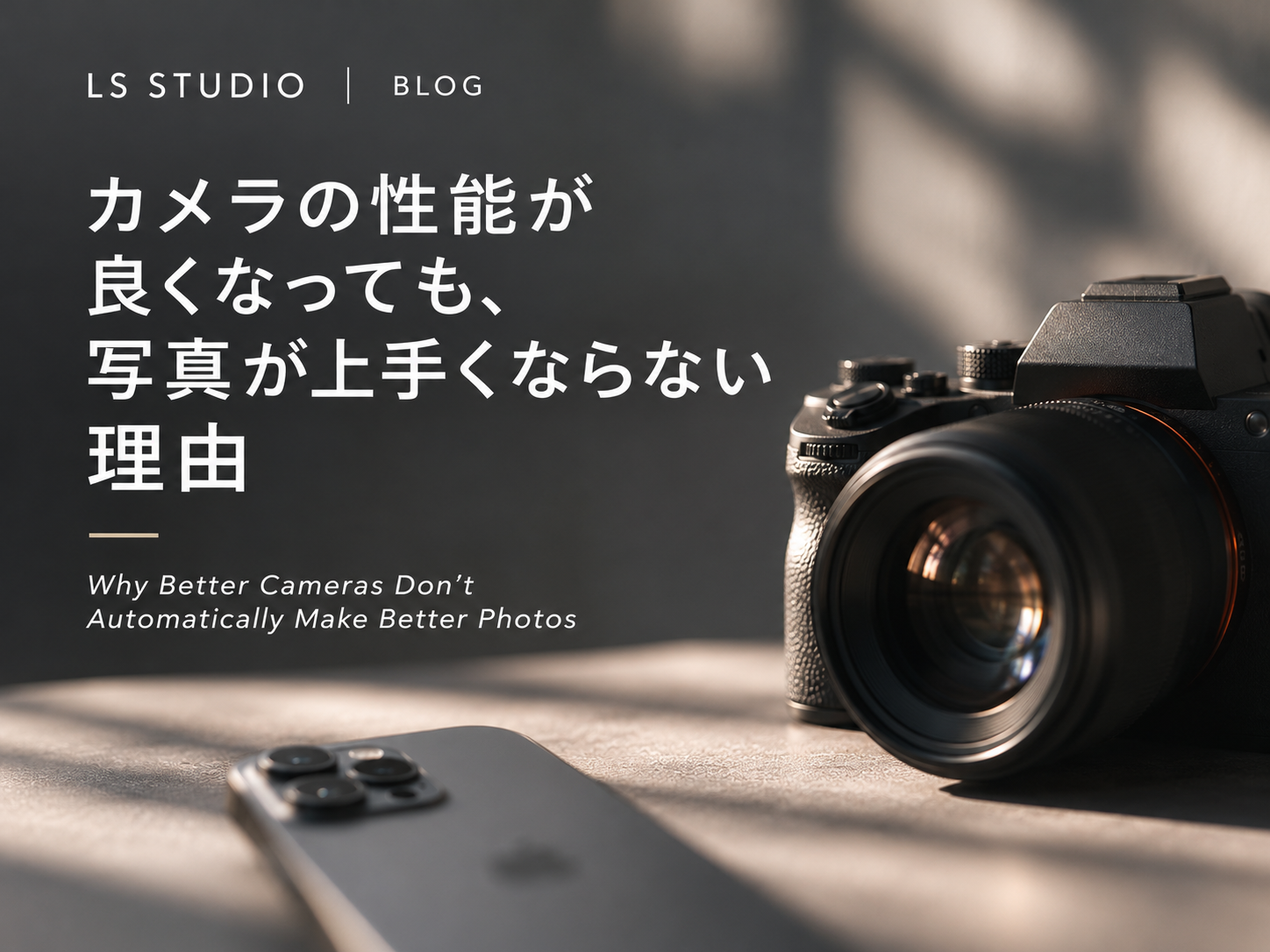
Why Better Cameras Don’t Make You a Better Photographer
Journal / Case StudySNS
A high-quality image and a good photograph are not the same thing.
The evolution of cameras is truly remarkable.
High-performance autofocus, image stabilisation, high-ISO shooting, and AI-powered image processing.
Shots that once required specialist skill are now supported automatically by the camera.
Even on a smartphone, portraits with a blurred background and beautiful night scenes are easy to capture.
So why doesn’t buying a high-performance camera, on its own, make your photos better?
Working as a photographer, I often feel that a camera’s performance and the quality of a photograph are not necessarily proportional.
Of course, high-performance equipment has big advantages.
But the camera evolving and the photographer’s ability to see growing are two entirely different things.
01. What changes when cameras get better?
Using a high-performance camera improves the technical quality of the photos you can take.
You can keep noise down even in the dark.
It’s easier to focus on people moving quickly.
Higher resolution records every detail sharply.
Stabilisation lets you shoot steadily even in difficult conditions.
For photographers, these are very welcome advances.
Especially in work that records once-only moments — corporate events, weddings, surprise shoots at hotels — the reliability of the equipment matters.
But a sharp, high-quality photo is not necessarily a photo that stays with people.
Because there is something there besides technical quality.
02. A camera doesn’t tell you what to photograph
Imagine walking down a beautiful street.
Two people, in the same place, at the same time, with the same camera, take photographs.
One might photograph the whole building.
The other might be drawn to the light falling on a wall, or the shadow of someone passing by.
Both are valid photographs.
But the results will be completely different.
Why?
Because the two of them are looking at different things.
A camera can record what is in front of it accurately.
But the judgement of what you find beautiful, and what you want to keep, lies within the photographer.
A photograph is not the world the camera saw, but the world the photographer chose.
03. Understanding light matters more than camera performance
One of the things that most changes the impression of a photograph is light.
Even photographing the same person, the dimension of their face and their expression change with the direction and strength of the light.
Soft light from the front can suit a friendly, clean impression.
Light slanting in from the side, on the other hand, emphasises contours and creates a calmer mood.
The same is true for product photography.
The texture of ceramics, the reflections on metal, the transparency of glass.
To show each material at its best, how you handle light becomes essential.
A high-performance camera faithfully records the light that is there.
But which light to use and which shadows to keep is for the photographer to decide.
And you don’t necessarily need expensive lighting equipment.
Using natural light from a window, or moving the subject slightly, can sometimes change a photo dramatically.
To take good photographs, I think it’s important not just to learn camera settings, but to develop your ability to observe light.
04. Good photographers are good at subtraction
When you start taking photos, you tend to want to capture as many of the beautiful things in front of you as possible.
Beautiful architecture, an attractive person, a striking background.
But trying to fit everything into one frame can make it unclear what the photo is trying to say.
Take a hotel room shoot.
Rather than trying to show the whole room, building the composition around the light coming through the window and the garden beyond can convey the appeal of the space better.
In portraits too, just having unnecessary things in the background scatters the viewer’s attention.
Shift your position a little.
Change the camera height.
Take unnecessary things out of the frame.
Those small choices change the impression of the photo enormously.
Getting better at photography isn’t only about being able to capture more.
It is learning to judge what to show, and what not to show.
That sense of subtraction is also an important part of building a photograph.
05. Timing isn’t decided by performance alone
Today’s cameras can shoot very fast bursts.
You can follow a moving person and record a huge number of frames.
But even if you can shoot hundreds of frames, choosing which one to keep is another matter.
Say you are photographing a speaker at a corporate event.
Rather than just capturing them talking, you want the moment their words carry real force, or the moment the room comes together.
In a portrait, the moment the nerves ease and the person smiles naturally.
At a hotel proposal, the moment the expression turns from surprise to joy.
In situations like these, anticipating what will happen next is key.
A high-performance camera helps you capture that moment without missing it.
But what you feel is the important moment —
that is where the photographer’s experience and sensibility show.
06. In portraits, communication can matter more than the camera
There is one more thing not to forget in portrait photography.
The relationship with the subject.
However advanced the camera, it’s hard to draw out a natural expression if the person stays tense.
Especially with executive profile photos, or portraits of people who are rarely photographed, the conversation before the shoot can be crucial.
Chatting about nothing in particular, or asking about their work.
As the tension eases little by little, a different expression appears.
I don’t think a portrait is something the photographer creates one-sidedly.
The subject and the photographer share the same time, and the photograph is born from that relationship.
However far camera performance advances, I don’t think this part is easily replaced.
07. A good photograph — good for what?
Another important point is the purpose of the photograph.
An advertising photo needs to convey the appeal of a product or brand.
Architectural photography is expected to express the space, structure and materials the architect envisioned.
For a corporate portrait, what may matter most is building trust in the person and the company.
Equally beautiful photos are judged differently depending on their purpose.
Not only the quality of the photo itself, but who it is for and what it needs to say.
Understanding that purpose is especially important in commercial photography.
Better cameras have made it easier for anyone to take beautiful photos.
That is exactly why professional photographers are expected to do more than just shoot beautifully.
08. As AI evolves, how does being “good” at photography change?
AI is changing the world of photography even further.
Focus correction, noise reduction, removing unwanted objects, colour correction.
All of this has become far easier than before.
You can even generate photo-like images without using a camera at all.
So is there no longer any point in learning photographic technique?
I don’t think so.
If anything, the easier it becomes to make technically beautiful images, the more important it becomes what the photographer wants to express.
What kind of world are you seeing?
What interests you, and what do you find beautiful?
And why do you want to keep it as a photograph?
Facing questions like these is, I think, what deepens photographic expression.
09. What it takes to get better at photography
So what should you do to get better at photography?
I think that, rather than buying a new camera, the first thing is to look closely at what is around you.
Even on a route you take every day, the light changes with the time of day.
The same building shows a completely different face on a sunny day and a rainy one.
The same person’s expression changes between when they are talking and when they are deep in thought.
Noticing those differences.
And looking back at your photos and asking why you thought a particular one was good.
Getting better at photography may be less about getting used to operating a camera, and more about the way you see the world gradually changing.
10. The value of a professional photographer, as LS STUDIO sees it
At LS STUDIO we use a range of cameras, lenses and lighting depending on the purpose of the shoot.
Equipment performance matters for delivering photos of consistent quality.
But what we value most is not the equipment itself.
Reading the light, observing the subject, and thinking about the expression that suits that place and person.
Understanding what the client wants to communicate, and delivering that value through photography.
And making a single photograph stay in someone’s memory and feelings.
That is what I want to hold on to as a photographer.
With a high-performance camera in hand, taking beautiful photos is easier than ever.
But taking a good photograph requires one more thing.
The photographer’s own way of seeing the world.
Change your camera, and the image quality changes.
But change the way you see, and the world in the photograph itself changes.
That, I believe, is what makes photography so interesting.
LS STUDIO | Photography & Creative Production
Kyoto, Japan