
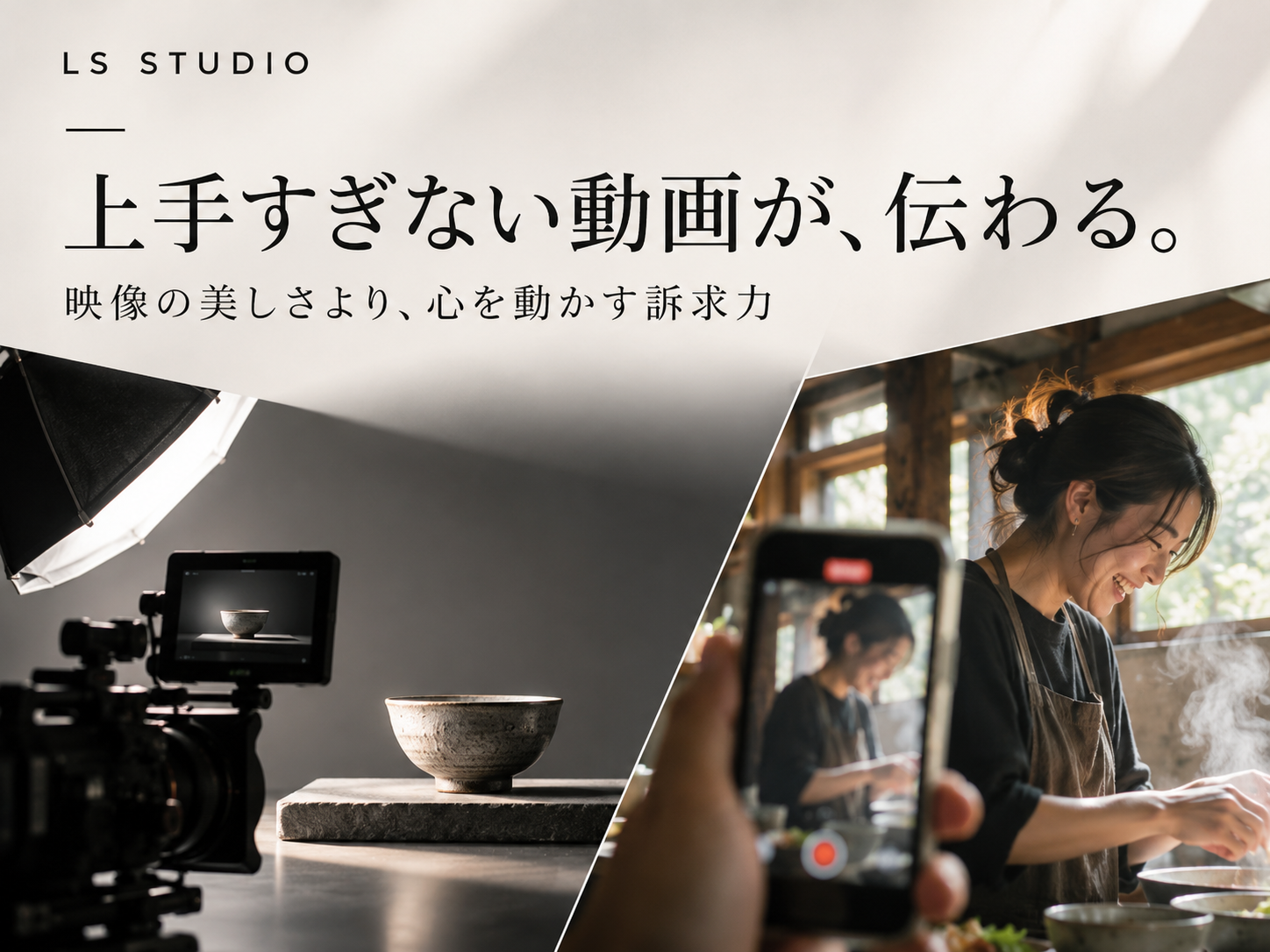
Sometimes a Less-Polished Video Says More
CommercialCreative & ProductionJournal / Case Study
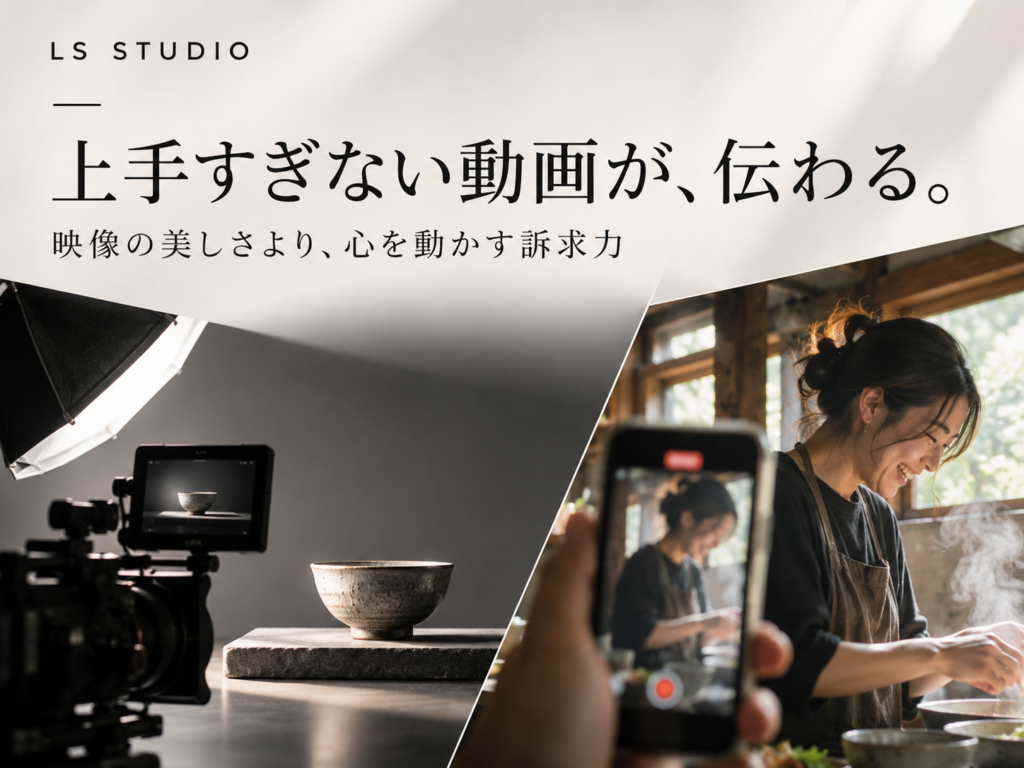
Beautiful footage and footage that moves people are not the same thing.
A video shot casually on a smartphone can draw a far bigger response on social media than a beautiful promotional film that cost hundreds of thousands of yen.
That is happening in the world of video today.
Beautiful lighting, perfect composition, smooth camera moves, and meticulously planned editing.
The craft that professional photographers and filmmakers have pursued does not always move the viewer.
In fact, a little camera shake, an unsteady frame, someone stumbling over their words mid-sentence —
a video that is “not too polished” sometimes reaches people more deeply.
Why is that?
01. Footage that is too beautiful looks like an ad
When a perfectly produced ad appears while we scroll through social media, we instantly — almost unconsciously — recognise it as an ad.
Of course, beautiful footage has the power to draw people in.
But footage that is too finished can create distance between the viewer and the sender.
An everyday video shot on a smartphone, on the other hand, feels less like an ad and more like a glimpse into someone’s life.
Take a video introducing a restaurant’s food.
Perfectly lit food shots are appealing, but a clip of the chef in the kitchen saying, “Today’s dish is seriously good,” can make people want to go and eat there even more.
The polish of a video and its power to communicate are not necessarily proportional.
02. “Imperfection” creates reality
Camera shake, natural light, ambient sound, the unexpected.
In typical video production, we try to control these as much as possible.
Yet that imperfection can actually make footage feel more real.
Think of a craftsperson at work.
A beautifully staged film of the workshop is wonderful, but a close-up of the craftsperson’s hands, with their conversation and the sound of the tools left in, has a charm of its own.
Time flows there without being over-calculated.
A little imperfection may be what makes the viewer feel, “This is really happening.”
But the important point is that this does not mean you should simply shoot badly.
Looking natural and being careless are two different things.
03. The skill of deliberately not shooting “too well”
A professional filmmaker might deliberately shoot with a smartphone-like look.
Shoot handheld instead of on a tripod.
Use the natural light in the room instead of perfect lighting.
In the edit, leave pauses in, or cut together shots that are slightly uneven.
None of this is a lack of skill.
It is a creative choice made with the distance to the viewer in mind.
Films and commercials, too, sometimes use documentary-style techniques.
The camera follows a person, the framing sometimes breaks, and unpredictable movement happens.
Footage like that has an immediacy that perfectly controlled footage does not.
In other words, what is asked of a professional is not only the ability to shoot beautifully, but the judgement to not shoot too beautifully when the purpose calls for it.
04. What matters is impact, not view counts
There is one more thing to think about in video production.
The purpose of the video.
Do you want more views?
Do you want to convey your brand’s world?
Do you want people to buy the product?
Do you want to build trust in a company or a person?
The best video depends on the goal.
For a luxury hotel’s brand film, footage that carefully portrays the beauty of the spaces and the quality of the service may be right.
But for a social video in which hotel staff show what goes on behind the scenes, a friendly, smartphone-style look may do more to close the distance with viewers.
Even videos about the same hotel can play very different roles.
A video with lots of views does not necessarily lead to sales or enquiries.
Who do you want to reach, what do you want to say, and what do you want them to do?
If you are thinking about a video’s impact, that is where to start.
05. In the age of AI, imperfection becomes valuable
AI has made it far easier to create beautiful footage than ever before.
It can now generate spaces and people that don’t exist, even cinematic camera moves.
Meanwhile, the more perfectly polished footage there is, the fresher it may feel to see real people talking, moving and making mistakes.
Misspeaking, bursting into laughter, something unplanned happening.
Moments like these have a charm that pre-planned staging does not.
Of course, imperfect does not mean anything goes.
What matters is finding the genuine appeal that is already there.
You can use AI and advanced techniques to make perfect footage.
And still choose to leave the humanity in.
I think video production from here on needs that option too.
06. How LS STUDIO approaches video
We care about the craft of finishing footage beautifully.
But what matters even more is what the footage communicates.
Some projects need beautiful footage; for others, natural, rough footage is more effective.
The key is not to fix the final form before shooting, but to think about the client’s goals, the platform, and the distance to the viewer.
Sometimes as beautiful as a film.
Sometimes as natural as a documentary.
And sometimes as unpretentious as something shot on a smartphone.
Making that choice is part of our job as filmmakers.
07. Not footage that is good, but footage that gets through
When you pursue the craft of photography and video, you inevitably think “more beautiful” and “more polished.”
That in itself is not a bad thing.
But when honing the craft becomes the goal, you can lose sight of what you originally wanted to say.
Viewers are not necessarily judging the camera’s performance or the lighting technique.
They find it interesting, they relate to it, they want to share it with someone.
Those feelings are what create a video’s value.
Shooting well and communicating well are not the same.
And choosing not to shoot “too well” may be one of a professional’s skills.
LS STUDIO | Photography & Creative Production
Kyoto, Japan